Expanded workshop descriptions.
Agenda - Thursday and Friday November 19th and 20th, 2009 at Norris University Center, Northwestern University, Evanston, IL
Below is the schedule of workshops for the Tutor/Mentor Leadership and
Networking Conference which will be part of the next conference, to be held
on November 19 and 20 at the Northwestern University campus in Evanston.
If you'd like to present a workshop at a future conference,
or be part of one of the tutor/mentor program panels, such as described below, email tutormentor2@earthlink.net
to discuss your involvement.
Review detailed descriptions of workshops here.
Thursday November 19th, 2009
Registration - 8:00 to 9:00 am
Keynote and welcome: 9:00 am to 9:30 am
The State of Funding for Tutoring and Mentoring Programs and Non-Profits - Jill Zimmerman, Vice-President, The Alford Group
The
presentation will provide the following:
* Overview of the non-profit sector
* Drivers that will influence changes in the future
* Review of 2008 Charitable giving
* Future predictions for 2010
* 12 Recommendations for 2010
Presentation PDF (TC)
Strengthening NonProfits White Paper, a May 2008 White Paper Commissioned by the Wallace Foundation
First workshops: 9:40 am to 10:50 am -
Volunteer Recruitment and Retention Strategies
Panel discussion led by
leaders of tutoring and/or mentoring programs. Leaders share strategies
for recruiting volunteers from businesses, universities, professional groups who
serve as tutors/mentors, and as board members, technology support, organizers,
and capacity builders.
Facilitated by Nicole White, Tutor/Mentor
Connection; Panel Includes: Samantha Boddapati,
CPS Educational Support for Students
Living in Temporary Living Situations, Gregory Girsch,
LINK Unlimited, Sarah Hardin,
Chicago Youth Programs, Scott
McFarland, SERVE Illinois Commission
You are the Best! Strategies to Keep Mentors Happy - Presented by Xavier Salvado, Gads Hill Center
Why are mentors volunteering in your program? What makes them choose to stay with you? What makes them leave? This workshop will explore different strategies that you can use in your program to ensure that your mentors feel that they are making a difference and are willing to stay longer with you!
This workshop will explore the reasons that make people
volunteer, and how one must make sure that your volunteer position is
considering all those reasons when planning the volunteer job description. The
session is intended for any level of program staff (we will discuss mentoring
programs, but it can be applied to tutoring programs as well).
Lessons to take away:
- Most mentoring programs would not exist without volunteers. Therefore, mentors
must be considered a fundamental piece in any program decision.
- It is crucial to know what your volunteer's expectations are.
- If a mentor/volunteer does not feel engaged & valued, he/she will leave the
program.
- It is easy to keep your mentors happy!
Literacy Roundtable Quarterly Meeting - Led by Jenne Myers, Working in the Schools (WITS), http://www.witsinchicago.org
Like a collection of books, The Chicago Collection is a committed group of
local literacy non-profits whose missions all revolve around promoting literacy
in and around Chicago for adults, children and families that need it most.
With program staff and leadership committed to meeting on a quarterly basis to
discuss challenges, ideas and strategies, we hope, as a collective group, to
work collaboratively as advocates for literacy related issues and to find ways
to work smarter together. Participation will also reinforce and improve our
strengths in the not-for-profit literacy landscape.
Summary of Literacy Roundtable meeting, PDF
Building a Job Training and Career Development Program for
Youth - Presented by Alex Cornwell,
Associate Director and Stacy Jackson, Director of Chicago Lights Tutoring and Summer Day
Program at Fourth Presbyterian Church
http://www.chicagolights.org
This workshop will explore the “how-to” of creating and managing a successful
job training and career development program for high school students.
Participants will learn about the resources needed, share ideas on building a
curriculum, and discuss the potential challenges and overall impact of a job
training program for youth.
All tutor/mentor programs share the goal of positively contributing to the lives
of youth. Generally that means providing the insights and tools youth will need
in order to have a satisfying career as adults. This workshop will explore the
“how-to” of creating and managing a successful job training and career
development program for high school students. The design model for job training
and career development used within the Chicago Lights Tutoring Program will be
shared so that participants will learn about the resources needed to start a
career development program, the nuts and bolts of designing a successful
program, and the potential obstacles this type of program may encounter. Ideas
on building an interesting and comprehensive curriculum for youth will be
explored so that participants may design a program to fit their needs.
How to Help Your
Students Finance College.
Presented by Annette Phillips,
Outreach Liaison,
Illinois Student Assistance Commission
Yes, our students can go to college! This interactive session will introduce you to ways to pay for college, trusted sources of information, the Free Application for Federal Student Aid (FAFSA) form, and frequently asked questions. At this can't miss session you will receive samples of ready-to-use printed materials and become aware of interactive tools on the Web to help families manage the cost of college.
Second workshops: 11:00 am to 12:15 pm
Impact
Evaluation: From Basics to Best Practices,
Presented by
Susie Quern Pratt and
Jenny Ellis Richards,
Pratt Richards Group, Evanston, IL.
www.prattrichardsgroup.com
Every
nonprofit struggles with the notion of impact - how to understand, define and
measure it; good, ongoing, evaluation practice is the place to start. This
session is will provide an overview of evaluation definitions, tips and tools
useful for learning about and articulating your impact. Participants will become
better acquainted with
common evaluation terms and concepts and will leave with some new ideas for,
and approaches to, evaluation work.
This session will be interactive, and is open to all - nonprofit Executive
Directors and program staff, board members, volunteers. If you attended this
workshop in May, come again and share how you have used this information in your
own planning.
View the
PDF presentation of
this workshop from May 09 conference.
Building Communications Skills in the Classroom and
After-School
Presented by Elizabeth Condon, Leap Learning Systems
Participants will be introduced to two of Leap Learning Systems programs for
school-age through high school students, and youth leaders who work with
students in both classroom and after-school environments.
LASER (Leap's After School Enrichment Curriculum)
teaches educators working in the after-school setting key language and literacy
building strategies so that they can help students with poor academic
achievement in grades one through seven to improve their reading skills. Language
for Scholars teaches students effective communication skills so that they are
understood and responded to positively by their teachers, employers and peers.
The presentation will review activities that have been successful in
improving students' academic standing in schools and after-school centers in
Chicago. We will also touch on how to find funding for partnering with outside
vendors and professional development providers.
This presentation is intended to serve leaders, volunteers and anyone who
works with youth in a classroom or after-school setting.
Participants will learn best practices for engaging youth in academics during
after-school hours, and how to help their students develop strong communication
skills. A review of effective evaluations will be discussed, and participants
will also learn how to forge successful relationships with professional
development providers.
Maximize Youth Potential Through Academic Mentoring, presented by David Neils,
Executive Director, International Telementor Program,
http://www.telementor.org
Learn how a powerful academic mentoring program can put your students on the map
in the areas of academic excellence in the core as well as solid career and
education planning that is challenged and supported by the best professionals in
the world. Thousands of GEAR UP students have been served and we welcome
participation from staff representing federal and state education programs.
This workshop is for teachers, principals, administrators, government officials,
and corporate managers who are interested in substantially raising the bar on
academic performance and helping students become informed, connected and engaged
with the help of successful professionals serving as mentors.
Online Fundraising 101 for Small Non-Profits - Desiree Vargas, President
and Co-Founder and Ethan Austin, Co-Founder and Second Banana, GiveForward,
http://www.giveforward.org
Long gone are the days when golf fundraisers and charity galas were the only
ways to raise money. In this session you will find out why more and more small
non-profits are turning towards online fundraising tools to empower their
supporters to become fundraising superstars.
This session will go over the basics of online
fundraising and will show you how your organization can get started. We
will discuss some of the different online fundraising platforms in the industry,
as well as go over fun and easy ideas to get your supporters excited about
raising money for your organization.
This session is geared towards non-profit staff members who are looking to
improve the effectiveness of their fundraising efforts. It will also be
informative to volunteers who would like to learn how they can more easily
support the organizations they care about.
You will learn:
* The difference between a "donate now button" and a personal
fundraising page
* The differences between online fundraising platforms such as Kintera,
FirstGiving, ActiveGiving and GiveForward
* How to get your staff, donors, supporters and board members to start
fundraising for your organization
GiveForward is a Chicago-based social venture started by two people who had the idea that they could change the world by making it super-duper easy for people to raise money online for the things they care about
Tutoring Program Strategies - Jennifer Bricker and Devon
Lovell, Family Matters,
http://www.familymatters.org
Tutoring can be fun! Participants of this session will explore several hands-on activities that they can adapt and bring back to their tutoring programs. Easy-to-produce math games, manipulatives for teaching reading, and general tutoring activities will be covered. Come discuss innovative ideas that can transform tutoring sessions from school-like bookwork to creative learning experiences, and engage a few of the experiences yourselves!
Lunch &
Networking - 12: 15 pm - 1:30 pm
12:50pm to 1:15 pm - Keynote Speaker
How Businesses and Non-Profits can Work Together by Providing Volunteers and their Skills - Tim Hogan, Partner/Creative Director, The Royal Order Experience of Design
In this session, Tim Hogan describes experience with T/MC first as volunteer art teacher, then as digital agency partner. As an introductory project, Tim's company has taken on the task of redesigning the tutormentorconnection.org website. Small business owners with a staff of motivated volunteers and interns can dedicate skills and resources on a regular basis, when the non-profit organization is serviced as an actual client.
PDF OF Tim Hogan's presentation
First Afternoon workshops: 1:45pm to 3:00 pm
Social Media Game - Twitter - How It Can Benefit Tutoring and Mentoring
Programs, presented by Lovette Ajayi of Community Media Workshop.
http://www.newstips.org
It's easy
to get overwhelmed deciding which social media tools your organization should
use. Play the Social Media Game with Community Media Workshop to think about how
to intentionally use those tools despite, or even because of, resource
challenges.
Also, if you're wondering what the hype about Twitter is and how it benefits
you, this workshop is the one for you. Join as we discuss Twitter best practices
and ways your organization can use it to further your mission.
This workshop will is intended to serve those charged
with advancing the missions of their organizations. Marketing and public
relations staff, or anyone who does communications for their organization.
Attendees can expect to take away a better understanding of Twitter and why it
has become the newest go-to place for organizations engaging in social media.
Student Recruitment Panel Discussion. Where do programs recruit students?
How do they build regular participation, parent and school involvement? Facilitated
by Kathy Anderson, Wicker Park Learning Center http://www.wickerparklearningcenter.com/,
Abby Kritzler, Dreams for Kids,
Allison McKenna, Lifelink Foster Care and
Latino Family Services
The speaker
will talk about various ways to recruit students. The most important message she
will share is that being open to the needs of the students helps a lot in
recruitment as well as keeping students and getting additional students. She
will discuss how thinking outside the box has always helped her over the years in getting
and retaining
students. Parents like to know they have options in terms of location and
days and times of tutoring. They also value communication from the tutor as
well the program leader. They need to get a sense that you care about their child and
that their child is not just one of the students that you work with. Also, being
available to talk with the parents and be a liaison between the parent and
school is also very helpful.
Model-Coach-Fade - How to Teach Anything - Presented by Joshua Fulcher,
Erie Neighborhood House,
http://www.eriehouse.org
This workshop provides and teaches a structure for tutors to build a student's
skill set for sustained academic improvement. It is a structure to teach
virtually anything so students can work on their own. This method is used by
Masters in Education programs across the nation.
This is a workshop for coordinators/directors to take back to their programs and train their tutors with. It is a training used to train tutors at Erie Neighborhood House. The workshop gives tutors a skill set or an approach to use when tutoring their student. So often we teach kids how to do one particular problem instead of how to do ALL the problems of that type. This is a method that tutors can use so that when the student goes home, they can finish their homework, on their own.
Using Maps to Create Collaborative
Strategies. Presented by Daniel Bassill, President,
and Mike Trakan, GIS Map Developer, of Tutor/Mentor Connection (http://www.tutormentorconnection.org ).
Bassill and Trakan will overview
collaboration strategies and uses of
maps to draw volunteers and
donors to different neighborhoods of a city, and to all tutor/mentor
programs in each neighborhood. The speaker will also show how Google
Maps can be used to locate potential business, church and civic
partners in the same neighborhood of tutor/mentor programs. Demonstration
of
http://www.tutormentorprogramlocator.net will be included.
Second Afternoon workshops: 3:15 pm to 4:30 pm
Creating Great Connections - The Basics of Brain Development - Presented by Deborah McNelis
-
Brain Insights
This workshop provides an overview of the basics of
brain development. Through visual demonstrations you will gain insights into
how you can have more impact on the learning brain. With this understanding,
ideas are are also presented on how we can spread the word to those that can
support of the needs for all young children.
This is designed for volunteers, leaders, and funders. It is meant to inspire everyone in an effort to support learning at any level.
Incorporating Writing Strategies into a Tutoring Program.
Presented by Patrick Shaffner, and Kait Steele,
826 CHI
One of the largest areas of academics that students lag behind in is writing.
Find out how one program incorporated writing into their tutoring program and
has made writing fun for thousands of kids not just in Chicago - but in Boston,
Los Angeles, Michigan, New York, San Francisco, and Seattle too!
Issues of Non Profit Management - 10 Tips for Staying Ahead in this Economy Presented by Jennifer Paul and Liz Livingston Howard, Northwestern University Center for Non-Profit Management, www.kellogg.northwestern.edu/research/nonprofit/index.htm
All nonprofit organizations are facing significant challenges in this economy. However this is not the time to suspend fundraising and marketing activity. This session will help leaders review critical elements of successful fundraising and marketing strategies.
This session is geared for nonprofit leaders and will help them review critical elements of fundraising and marking, think about key ways to maintain your strengths, and discuss current strategies to engage and cultivate stronger relationships.
Talking To Youth About Dating Violence - Presented by Mary Adele Revoy, Adolescent Development Specialist, Revoy Presentations, www.whoisrevoy.com
An educational seminar for mentors on the basics of adolescent brain development and the dynamics of teen dating violence. Topics include: basics of early and adolescent brain development; changes during puberty; thinking areas still developing; power of emotions; risky behaviors & passion; and the dynamics of dating violence.
This educational seminar is for leaders, volunteers, mentors and parents on the basics of adolescent brain development and the dynamics of teen dating violence. Topics include: the basics of early and adolescent brain development; changes during puberty; thinking areas still developing; the power of emotions; adolescents' interest in risky behaviors & passion; and the dynamics of dating violence. Participants will receive information that will help them understand and relate to developing adolescents. For example, participants will discuss how puberty is related to brain development and how both can impact decisions and behavior. Moreover, participants will participate in a fun activity to understand the thinking areas that are still developing in the adolescent brain. In addition, participants will be given ideas on how to talk to youth about healthy dating practices and what kind of dater they want to be. These ideas will be supported by a packet of worksheets and handouts that the adults can share with the youth. If time allows, information will also be shared on the youth workshop that is offered in schools and community groups that address the changes in their own brains and considerations when they date.
Friday November 20th, 2009
Registration - 8:00 am to 9:00 am
9:00 am to 9:30 am: Keynote and welcome:
Testimonial from a former student.
Isaiah Brooms, Director of Admissions at
Westwood College - Virginia Ballston Campus
Isaiah Brooms is a long time alumni of The Cabrini Green Tutoring Program
(Currently, Cabrini Connections). Formerly a teacher in the Chicago Public
School System, he relocated from Chicago to recruit, coach and teach at a
private school in Indiana, and is currently the Director of Admissions for
Westwood College located in Arlington, VA. Isaiah spent his formative years
living in Cabrini Green. However, at the age of fourteen he was awarded an
academic scholarship to attend a private boarding school in Indiana. That
experience changed the course of his life and set him on the path to who he is
today. He attributes all his success to God and to the amazing mentors and
coaches that invested the time and energy into helping him become a healthy
child and more importantly giving him the courage to dream big.
First workshops: 9:40 am to 10:50 am -
Understanding Tutor/Mentor Program
Distribution in Chicago. Examples of student learning as a practical
application.
In this session first year students from DePaul University will discuss what
they have learned about Chicago, and what they have learned about the different
tutor/mentor programs operating in Chicago.
The goals of this project were describe as:
"This quarter, our Explore Chicago: Growing Up
in Chicago class will be researching, analyzing and projecting the need for
Tutoring/Mentoring services in various areas of the city. We are working closely
with Cabrini Connections, a tutoring/mentoring program that serves the children
who live in Cabrini Green, a Chicago Housing Authority complex located near the
corner of Halsted St. and Chicago Ave. The students will also be writing
narratives about their work in the hopes of sharing information about
tutoring/mentoring programs in Chicago with other interested people. Watch for
the students’ weekly posts and follow the progress of their research."
Meet the students and read their Explore
Chicago blog articles. Read
more about this project.
Two Part Workshop 9:40am till 12:15 pm - Building
Community Engagement: A Global Model with Local Foundations, Presented by Eric
Davis, Founder of the
Global Citizen Experience
GCE helps design and run customized
demonstration programs -- from summer programs to school-year workshops -- that
give
schools and organizations the opportunity to provide customized professional
development for their staff. GCE helps instructors plan design and implement
programs that connect curriculum across the spectrum of subjects and extend
classroom learning into neighborhoods, cities, and the world at large.
This is a "working workshop." We recommend that administrators, education
coordinators, and teachers participate, ideally in
teams of 2-5 people representing one organization. We will work through
portions of the assessment and visioning phases necessary to build school-year
and summer programs.
The Breakthrough Network Model - no superstars needed, Presented by Bill
Curry, Chief Operations Officer, Breakthrough Urban Ministries,
http://www.breakthrough.org
Often youth leaders feel the pressure to be everything to
every student. The pressures are great, so finding ways to share the burden and
the joy is important for a youth leader to last in the field. The Breakthrough
Network Model suggests an innovative approach to growing mentoring relationships
among a community of students and community of volunteers. This interactive
workshop could be a significant breakthrough for you and the kids you serve.
This workshop is intended to reach out to those starting up a program, as well as those who are in programmatic decision-making positions. The Breakthrough Network model works to surround each child/youth in the program with at least 7 caring adults who aren't paid to be in the life of the child. The approach runs programs that build needed skills in the student while increasing their access to long-term opportunities through the personal network they grow while in the program. The life transitions that take place for volunteers often leaves the student feeling abandoned, and the mentor feeling guilty when they leave a relationship. The Network Model works to decrease these feelings by not relying on a single mentor, rather builds that village that will partner with the parent to raise the child.
Nonprofits and Social Media: Well Worth the Effort! -
Presented by Holly Massey, Networker, Non-Profit Ingenuity
http://npoingenuity.blogspot.com
Does your organization use social media? Are you afraid of twitter? Do you utilize YouTube? This workshop will help professionals and volunteers learn about and become more comfortable utilizing social media.
Through actual demonstration,
participations will learn how they can utilize social media to publicize what
they are doing,
connect with like minded individuals and work more effectively with children and
youth. Even if you are VERY afraid of social media, you will come away with a
comfort level and an understanding of what it is all about.
Tutor/Mentor Connection is now on Twitter at
http://twitter.com/tutormentorteam
as a result of attending a workshop like this in the May 2009 conference.
Second workshops: 11:15 am to 12:25 pm -
Quantifying the Need: A multi-organizational collaboration
to develop a statistically valid methodology for the quantification of desired
frequency tutoring and mentoring programs - Presented by Bart Phillips,
President of the Board, Community-Building Tutors and Meredith Wroblewski,
American Statistical Association
Attendees will hear an overview of a project underway
designed to develop a novel approach to influencing public policy
around the necessary financial support of tutoring and mentoring programs in
political districts. The project centers around the development of an objective
measurement system designed to quantify the necessary frequency of tutoring and
mentoring programs in communities of varying socio-economic status.
This presentation is aimed at leaders of tutoring and mentoring programs as well as community leaders and leaders of educational institutions. The presentation will start with a detailed overview of the project plan which will highlight the roles of the invested parties: Tutor Mentor Connection; American Statistical Association; local elected officials at the Alderman, state representative, and state senate level; administrative leaders from the Chicago Public School system and the Noble Charter School Network; and business leaders. The presentation will conclude with the proposed methodological approach that will be implemented to quantify the need for tutoring and mentoring programs in various communities.
Following the presentation, the attendees will be asked to
contribute their perspective on the variables necessary to quantify the need for
tutoring and mentoring programs in different communities, different quantitative
and qualitative results of effective tutoring and mentoring programs, and
standard metrics that should be put in place to evaluate the impact of tutoring
and mentoring programs. Participants will have the opportunity to shape the
statistical model that will be developed.
Mentoring Program Strategies - Issues and Best Practices. Panel Discussion
Panel includes Joel Newman, Big Brothers, Big Sisters of the Mississippi Valley, Christy Beigh-Byrne, Director of Mentor and Volunteer Services, Chicago Youth Centers, Elliott Donnelly Youth Center, Rose Mabwa, Mercy Housing Services
Mentoring programs have their own special needs and issues that differ greatly from tutoring program. Talk to a panel of mentoring program leaders on ways to make your mentoring program a success!
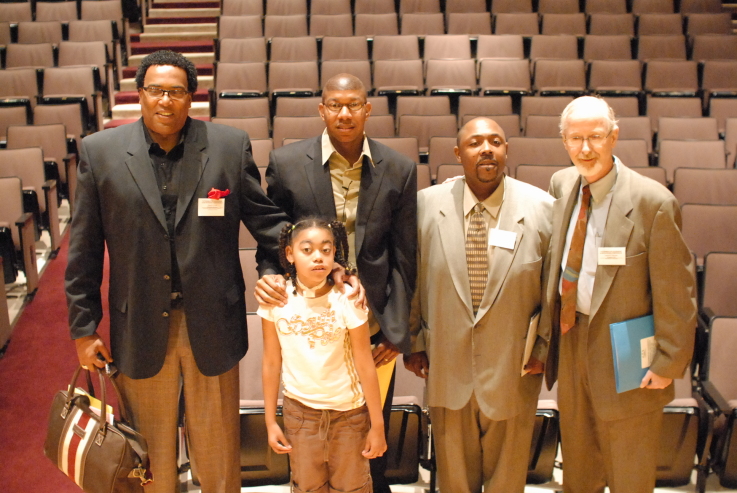
Engaging Athletes, Business Leaders and Celebrities as Advocates for Volunteer Based Tutor/Mentor Programs, panel discussion
In
this panel discussion current and former college and professional
athletes and business leaders will discuss ways to draw attention and
support to volunteer-based tutor/mentor programs throughout a large metropolitan
area, and ways that they might work together to
build more consistent year-round support of all tutor/mentor programs
in their host city. College and professional athletes and
coaches are encouraged to attend. This
PDF illustrates how Kurt Kittner, University of Illinois and NFL quarterback,
draws attention to Cabrini Connections, and other tutor/mentor programs in
Chicago.
Facilitated by Steve Miller, President of Legacy Mortgage Corporation
Panel members:
Kurt Kittner, University of Illinois and NFL Quarterback, associate
with Jones Lang LaSalle, Americas. Commentator with Illinois Football
broadcasts on WIND (560 AM) radio..
El Da'Sheon Nix, Northwestern University and current Administrative Coordinator of Cabrini Connections
Megan Godfrey, former University of Illinois golfer
and tutor/mentor at Oxford Learning in Arizona
Visit
http://www.giveforward.org/cabrinitmc to see a campaign led by Kurt Kittner
and El Da'Sheon Nix, to raise money for Cabrini Connections, Tutor/Mentor
Connection.
Lunch & Networking - 12: 30 pm - 1:20pm
1:20pm to 1:45 pm - Keynote Speaker -

Presented by Valdis Krebs,
http://orgnet.com/ and
Jean Russell, http://nurture.biz/
PDF OF
Thrivable Networks Presentation
Together, Valdis Krebs and Jean Russell explore, explain,
and empower thrivable communities. Valdis specializes in social network mapping
and analysis. Jean specializes in weaving and thrivability. Together, we work
with both online and offline communities in both for-profit and non-profit
organizations. Valdis has worked with organizations such as IBM, CDC, Cleveland
Foundation and Barr Foundation. Jean works with organizations including
PeopleBrowsr, Community Media Workshop, and Inspired Legacies. Together, Valdis
and Jean are working with several on-line social networks to weave thrivable
communities.
Social network mapping allows us to see how communities and organizations work
together. It helps groups understand how their connections help them be more
thrivable. In thriving communities, information and resources flow smoothly
from where these assets exist to where they can be best applied. There is a
sense that the well woven community becomes greater than the sum of its parts.
Possibility and opportunity abound.
Friday afternoon workshops: 2:00 pm to 3:30 pm -
Nudge the Net -- how do you mobilize your network to
accomplish your goals?, Presented by
Valdis Krebs, http://orgnet.com/
Jean Russell, http://nurture.biz/
Building a useful thrivable network is more than "networking" or it's on-line equivalent: "facebooking." We build a thrivable network not just for ourselves but for those around us. When we each improve our individual networks, we all improve our community network -- as long as we are connected and have open flows amongst us.
The old strategy in human affairs was: be between -- be the gatekeeper around what you know and what you have. Only allow select individuals or groups through the gate. Much of the world still works this way, especially hierarchies and bureaucracies -- you must pay to play. With the internet, and the transparency it allows, a new strategy is coming into play: be among -- be the connector of those around you. By developing the skill and reputation for connecting others, many will be drawn to you. Your network will grow for others will want to be connected to you -- to key individuals and groups you have access to.
Valdis Krebs and Jean Russell will walk you through this new strategy of building a thrivable network. You will learn the process, and experience the practice through workshop exercises. Valdis and Jean will explain the three, interconnected aspects of building a productive and thrivable network.
1) Know the Net -- how do you understand your network
and what it is today?
2) Knit the Net -- how do you improve your network to what it could be?
3) Nudge the Net -- how do you mobilize your network to accomplish your goals?
You will leave the workshop with actionable knowledge and
simple rules you can use every day to improve your network and that of
those around you.
Inspiring others to Dream Big - Sandra Garest, Executive Coach and Senior Dream Manager, Floyd Consulting, http://www.floydconsulting.com
This session provides an overview of The Dream Manager Program and ways to apply
the concepts in relationships and organizations. It will engage participants in
finding creative ways to lead others on their journey to finding and pursuing
their passions and removing barriers keeping them from achieving their full
potential.
Since the release of Matthew Kelly's best-selling book, The
Dream Manager, countless organizations have explored ways to apply the concepts
from the book to their people and teams. Organizations are seeing how the
concepts from the book encourage people to improve relationships, achieve
dreams, advance personal health, foster work-life balance and inspire teamwork.
How can volunteer organizations and mentoring relationships
inspire people to identify their dreams and provide ways to encourage them to go
after those dreams? What are the ways in which companies, teams, families and
mentors can implement concepts from The Dream Manager in their ongoing
activities and culture? This session will provide a brief overview of The Dream
Manager Program, provide ways to apply the concepts from the book to their work
and teams and engage the audience in finding creative ways to lead others on
their journey to finding and pursuing their passions.
Intended Audience:
Anyone interested in pursuing his or her dreams or anyone who has an interest in
helping other people pursue their dreams should attend. While the session is
appropriate for anyone interested in applying the concepts to their personal
life, it is particularly appropriate for managers, program leaders or mentors
who would like to create innovative programs to help students, volunteers or
members feel supported to go after their dreams and goals.
Expected Take-Aways:
After attending this session, participants will:
- Understand how The Dream Manager can positively impact organizations, teams
and families
- Have participated in a Dream Session to expand their personal Dreamlist
- Be able to lead a group through a Dream-Storming session
- Have brainstormed possible ways to apply the concepts from the presentation to
their own organization
-Have identified 3 dreams or goals that they can work on in
the next 90
days
IDES Career Resources Network - Presented by LaMarr Johnson, Illinois
Department of Employment Security
Demonstrations of One Source/Career Resources website that contain resources
essential for establishing a career plan are illustrated. Introduced are 3 steps
to a successful career plan: Explore Interests, Find Careers That Match &
Develop A Plan of Action. Topics included: Interest Profiler, Skills
Assessment, Job Search, CIS Portfolio; Reality Check.
Live internet or power point demonstration of IDES One Source/Career Resources Network website. It will serve tutors, counselors, advisors, mentors and parents that advise others in the academic area. Lesson 1: How to select a career. Lesson 2: Create portfolio to save assessment results and create/save resumes, course plans & favorite files.
Discussion of
Findings from Tutor/Mentor Connection Survey:
What are the issues
most important to you?
Panel Discussion led by Nicole White, Tutor/Mentor Connection Research and Networking
Coordinator and Mike Trakan, GIS/Mapping Coordinator - Tutor/Mentor Connection,
www.tutormentorconnection.org
We asked programs to rate what were their most important priorities at the start
of the 2009-2010 school year? There were eight needs for the programs to
prioritize. Nicole White summarized
survey comments
on her blog. These are posted below..
1. Finding operating dollars - This was the need that was given a
high priority by programs and 53.9% said it was the highest priority. 18.8% said
it was the 2nd highest priority, 6.3% said it was the 3rd highest priority, and
18.8% said it was the 4th highest priority. No one said it was the 5th 6th, 7th,
or 8th highest priority.
2. Recruiting and retaining volunteers - This was the need that was also listed
as the highest priority by 43.8% of the programs. 25% said it was the 2nd
highest priority, 18.8% said it was the 3rd highest priority, 6.3% said it was
the 4th highest priority and 6.3% said it was the 5th highest priority. No one
said it was the 6th, 7th, or 8th highest priority.
3. Training volunteers - While I think is a very important need, because where
is a program without properly-trained volunteers - it was judged by most to be
the 5th highest priority with 40% responding that way. No one thought it was the
highest priority, 13.3% felt it was the 2nd highest priority, 33.3% said it was
the 3rd highest priority, 6.7% felt it was the 4th highest priority, no one felt
it was the 5th highest priority, 6.7% said it was the 7th highest priority and
no one thought it was the 8th highest priority.
4. Legal support - This was felt to be the least important need right now with
78.6% responding that it was the 8th highest priority. No one said it was the
1st, 2nd, 3rd, 4th, or 5th highest priority. 7.1% said it was the 6th highest
priority, and 14.3% said it was the 7th highest priority.
5. Technology support- I was surprised that this was also not a very popular
need with 42.9% saying it was the 7th highest priority. We always are looking
for volunteers to help us with updating our websites and fixing our computers.
Maybe programs don't realize how important their websites are for marketing and
publicity and how important it is to have computers to help the kids learn.
Anyway, no one said it was the 1st, 2nd, or 3rd highest priority, and 7.1% said
it was the 4th highest priority. 21.4% said it was the 4th, and 21.4% said it
was the 5th highest priority. 7.1% said it was the 8th highest priority.
6. Marketing and publicity - I feel like this coincides with funding because
programs won't get funds if people don't know about them. This is why 35.7% said
it was the 2nd highest priority even though no one said it was the highest
priority. 21.4% said it was the 3rd highest priority, and 21.4% said it was the
4th highest. No one said it was the 5th highest, 14.3% said it was the 6th
highest, 7.1% said it was the 7th highest priority, and no one felt it was the
8th highest priority.
7. Parental support - This was the only other need judged to be the highest
priority other than finding funds and recruiting volunteers. 6.7% said it was
the highest priority, but the majority of people judged it to be either the 4th
or the 6th highest priority with 26.7% responding those ways. 6.7% also said it
was the 2nd and 3rd most important need, 13.3% said it was the 5th highest
priority, and 6.7% said it was the 7th and 8th highest priorities.
8. School Support - This was not the biggest priority either with the majority
of the responses saying its the 6th most important priority at 26.7%. No one
said it was the highest priority, 6.7% said it was the 2nd highest priority,
13.3% said it was the 3rd and 4th highest priority, 20% said it was the 5th
highest priority, 13.3% said it was the 8th highest priority, and 6.7% said it
was the least of the needs.
This will be one of the final workshops/discussions of the two-day
conference. However, it is one that we hope will propel people into further
networking and collaboration with each other, and the Tutor/Mentor Connection,
in the next few months, so we can innovate solutions to some of these challenge.
Plan to attend and bring your own ideas.
Workshop Tracks:
There will be 4-5 workshops available during each time slot with time between each for networking and information sharing among participants. The T/MC invites participants to think of the conference as a meeting place where they can bring a group who are interested in creating more tutor/mentor programs in a specific area, or in a specific focus area, such as health careers, technology, arts, etc. Thus, if you'd like to organize a single workshop, or a conference within the conference, please contact us online or call 312-492-9614
-------------------------------------------------------
Back to Top of Page